

Photo: Simon_sees via Flickr (CC BY 2.0)
Vietnam Airports Guide Travel Guide
Plan your Vietnam airports guide with airport hubs, timing tips, customs procedures, and practical booking advice for smoother travel.
On this page
Vietnam's airports welcome millions of international travelers each year. Arriving at Hanoi's Noi Bai or Ho Chi Minh City's Tan Son Nhat requires understanding airport procedures. Last updated July 2026.
This comprehensive guide covers major international gateways and explains visa requirements and customs procedures. You'll learn ground transportation options, how to exchange money, and how to get a SIM card. We also share tips for choosing airlines and understanding domestic flight options. Avoid common travel pitfalls at Vietnam's busiest hubs.
Key Takeaways
- Vietnam's airports welcome millions of international travelers each year.
- Arriving at Hanoi's Noi Bai or Ho Chi Minh City's Tan Son Nhat requires understanding airport procedures.
- This comprehensive guide covers major international gateways and explains visa requirements and customs procedures.
- You'll learn ground transportation options, how to exchange money, and how to get a SIM card.
Take the route offline
Free: the Vietnam route starter
A two-week south-to-north route with real nightly rates by city, what to book first and how far ahead, region-by-region timing, and the transport costs between each leg — drawn from our published guides.
International Airports in Vietnam
Vietnam operates seven international airports serving long-haul and regional travelers. The three primary hubs—Hanoi, Ho Chi Minh City, and Da Nang—handle most international traffic. Secondary airports like Phu Quoc and Cam Ranh serve resort destinations.
Noi Bai International Airport in Hanoi sits 27 km north of the city center. Terminal 2, opened in 2015, handles all international flights with 96 check-in counters and 17 boarding gates. Buses from Noi Bai to downtown cost around 9,000 VND (~$0.35). Taxis run 300,000 to 450,000 VND (~$13–19 USD) for a 30–45 minute ride.
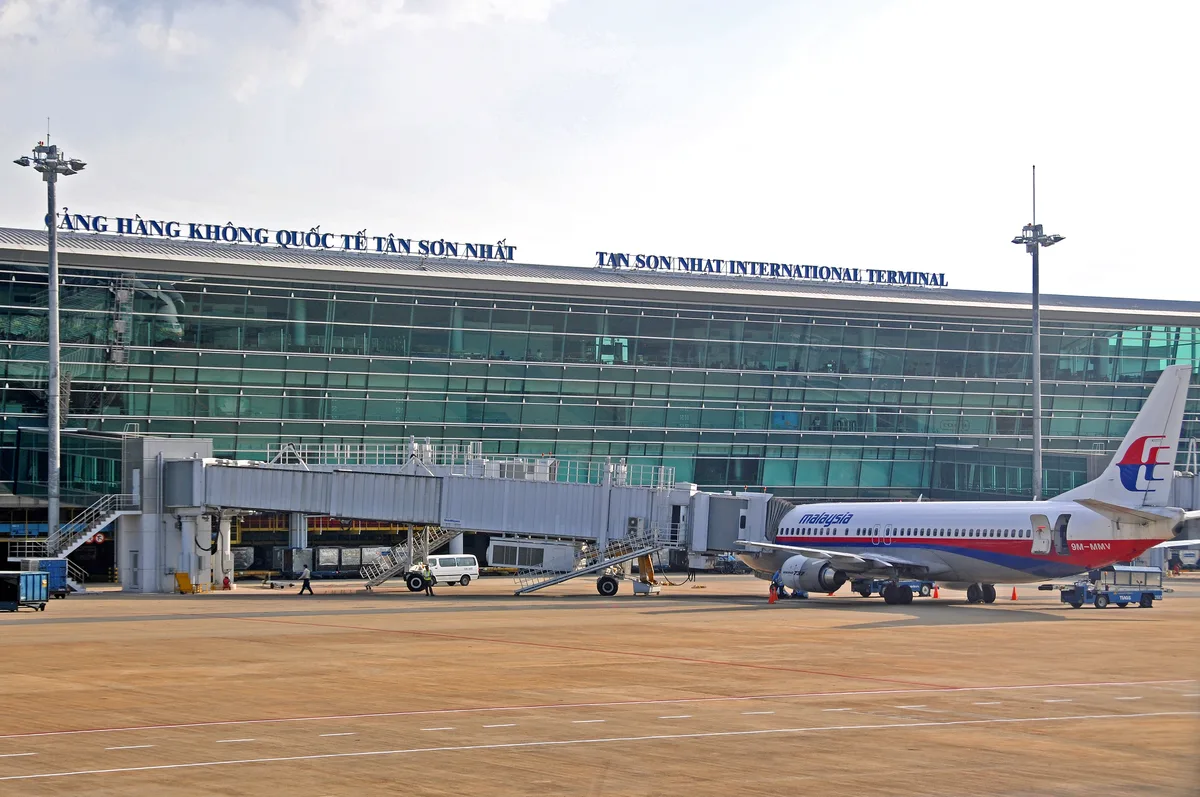
Tan Son Nhat International Airport in Ho Chi Minh City is Vietnam's busiest airport by passenger volume. Located 8 km south of the city center, it covers 1,500 hectares with separate domestic and international terminals. Terminal 3 is under construction to expand capacity. This airport serves as the primary gateway for international travelers heading to the Mekong Delta or southern coastal regions.
Da Nang International Airport serves the central coast and connects nearby tourism hubs effectively. Travelers reach Hoi An in 30 minutes or Hue in 2 hours from this airport. Shuttle vans run hourly from 5am to 11pm, offering affordable access to resorts and beaches. The airport handles both domestic and international flights, making it convenient for multi-destination Vietnam itineraries.
Secondary international airports include Phu Quoc Island, Cam Ranh near Nha Trang, and Phu Bai in Hue. Each offers basic facilities, shorter queues than major hubs, and direct road access to tourist destinations. These airports suit travelers seeking less crowded entry points or regional connections.
Domestic Airport Network
Vietnam's domestic network spans 10+ airports connecting regional cities and remote destinations. Flying between cities often costs less than long-distance bus or train travel. Book 3 weeks in advance on budget carriers to secure the lowest fares.
Major domestic airports include Cat Bi in Hai Phong, Phu Bai in Hue, and Da Lat in the central highlands. Budget carriers like VietJet offer short-haul flights for $40–50 USD one-way on routes under 300 km. Domestic terminals feature simpler layouts and shorter check-in queues than international terminals.
Booking strategy directly impacts your domestic airfare. Advance booking (2–3 weeks) on budget carriers saves significant money compared to last-minute fares. Compare prices across VietJet, Bamboo Airways, and Vietnam Airlines using Google Flights or Skyscanner.
Baggage allowances differ significantly between international and domestic flights. Most budget carriers limit carry-on to 7 kg (15 lbs) and charge extra for checked bags. Always verify baggage policies before booking to avoid expensive surprises at check-in.

Best Airlines Offering International Flights
Three main carriers dominate Vietnam's international market with distinct advantages. Understanding their strengths helps you balance cost, comfort, and convenience for your journey.
Vietnam Airlines is the national carrier with the most extensive international route network. It offers direct flights to Europe and Asia with full-service amenities and comfortable seating. Higher fares appeal to business travelers and those prioritizing premium comfort.
VietJet Air operates regional and long-haul routes at significantly lower prices than competitors. The airline runs airport shuttle services from Hanoi and Ho Chi Minh City, helping passengers save on ground transportation. Expect basic amenities like no free meals, but reliable schedules and competitive fares.
Pacific Airlines serves secondary routes and emerging destinations with often-lower fares. This carrier attracts cost-conscious travelers with flexible schedules. It appeals to explorers seeking niche markets and alternative routings.
Booking timing significantly impacts your airfare for international travel. For transatlantic routes (London to Ho Chi Minh), one-stop flights via Doha or Istanbul cost €550–650 return when booked 8–10 weeks ahead. Direct flights cost €700+ during the same booking window.
Vietnam Visa and Customs Procedures
Navigating visa requirements and customs clearance efficiently ensures smooth airport entry. Start the visa process well before departure and gather all required documentation.
Store your passport and visa approval letter in carry-on luggage within a dedicated travel pouch. If checked baggage is delayed or lost, having these documents accessible prevents complications. Never pack these critical items in checked bags.
Vietnam offers multiple visa pathways for international travelers with different needs. E-visa (online, 30 days single-entry) suits most tourists seeking simplicity. Visa exemption applies to ASEAN nationals, South Korean, and Japanese citizens. Visa-on-arrival requires pre-approval from a service provider and suits travelers who didn't apply online.
Your passport must be valid for at least six months beyond your intended departure date. Keep your passport and visa approval letter separate from checked luggage. Store them in a carry-on pouch for safekeeping throughout your journey.
Immigration queues at major airports typically last 15–45 minutes depending on arrival time. Queue length depends on the flight bank, staffing, and passenger mix, so no time window guarantees a faster arrival.
Customs procedures use a color-coded channel system for passenger routing. The green channel suits travelers with nothing to declare; red channel is for those carrying goods. Baggage allowances vary by airline and flight type; international flights typically allow more than domestic. Check the Vietnam Airports website for current regulations before packing.
Money Exchange, SIM Cards, and Ground Transport
Airport arrival involves several immediate priorities: securing currency, obtaining connectivity, and arranging transport. Handling these efficiently within the first 30 minutes ensures a stress-free transition to your trip.
Download Grab or Be apps before landing. These ride-hailing platforms provide transparent pricing and accept international payment methods. Apps work with your existing phone number, enabling seamless ground transport booking without needing airport SIM cards or Wi-Fi.
| Transport Option | Cost | Travel Time | Notes |
|---|---|---|---|
| Public Buses | 9,000 VND (~$0.35) | 60–90 minutes | Multiple stops; No. 86 Express runs 6:30am–11pm |
| Taxis | 300,000–450,000 VND ($13–19 USD) | 30–45 minutes | From major airport hubs to city centers |
| Grab/Be (Ride-Hailing) | $13–19 USD | 30–45 minutes | Transparent pricing; download app before arrival |
| Hotel Shuttles | Often free or discounted | Varies | Confirm availability when booking accommodation |
ATM machines throughout terminals dispense Vietnamese Dong at favorable exchange rates. Withdraw sufficient cash (500,000–1,000,000 VND or $20–40 USD) to cover taxi, bus, or initial meals. Not all local vendors accept credit cards, so cash is essential.
SIM cards and eSIM plans are available at kiosks near baggage claim and departures. Prepaid plans cost 50,000–200,000 VND ($2–8 USD) for 30 days of data with major carriers. eSIM options suit travelers with dual-SIM phones, eliminating the need to swap physical cards.
Ground transportation varies by budget and destination preferences. Public-bus fares, routes, frequencies, and operating windows differ by airport and can change. Check the airport or operator's live information before relying on a numbered route.
Taxis and ride-hailing apps offer faster but pricier alternatives than public transit. Taxis take 30–45 minutes for $13–19 USD to city centers from major airports. Grab and Be, Vietnam's leading ride-hailing platforms, provide transparent pricing; download before arrival for seamless booking. Hotel shuttles are often free or discounted; contact your accommodation upon booking to confirm availability.
Essential Airport Travel Tips and Procedures
Successful airport navigation requires advance planning and awareness of common pitfalls. These practical tips smooth your arrival and help you avoid frustration during peak travel times.
Arrive at least 2–3 hours before international flights to account for check-in lines. Security screening, passport control, and potential delays require buffer time. Domestic flights require 1.5–2 hours of advance arrival time.
Keep your passport and visa approval letter separate from checked luggage at all times. If luggage is delayed or lost, having these documents accessible prevents complications. Store them in a carry-on travel pouch distinct from other carry-on items.
Check the Vietnam Airports website for real-time flight schedules and facility information before departing. Terminal changes and gate reassignments occur frequently, especially at busy hubs. Current information prevents confusion and missed connections.
Terminal transfers between domestic and international operations require free shuttle buses. Allow 15 minutes for the journey between terminals at major airports. At Tan Son Nhat in Ho Chi Minh City, Terminal 1 (domestic) and Terminal 2 (international) are separate buildings.
Download the Grab or Be app before arrival to book rides immediately. These apps work with your existing home phone number and accept international payment methods. Ground transport becomes instantly accessible without needing a SIM card or Wi-Fi. If you miss your flight or need emergency assistance, contact your airline's customer service desk or visit the airport information center. Reboking typically happens same-day for most delays.
Long Thanh International Airport: Planning Future Ho Chi Minh City Transfers
Long Thanh International Airport in Dong Nai Province is being developed as a second major gateway for the Ho Chi Minh City region. It lies east of the city, considerably farther from central districts than Tan Son Nhat International Airport, so travelers should not treat the two airports as interchangeable when comparing flights or arranging transfers.
Check the airport name and terminal shown on your ticket before booking a hotel pickup, connecting flight, or onward bus. A transfer involving Long Thanh may require additional road time, particularly for accommodation in District 1, District 3, or areas west of the Saigon River. The airport may be more convenient for travelers continuing toward Bien Hoa, Vung Tau, or destinations along the southeastern coast.
During the transition period, airlines may continue using Tan Son Nhat while services are introduced at Long Thanh. Allow a generous connection buffer if an itinerary uses different Ho Chi Minh City airports, and confirm the transfer arrangement directly with the airline rather than assuming an airside shuttle is available.
Official Planning Checks Before You Go
Use the Airports Corporation of Vietnam directory for destination context and the official Vietnam Tourism transport overview for a second official baseline. Recheck any opening hour, fare, timetable, closure, access rule, weather risk, or booking condition with the responsible operator shortly before travel; an official destination overview is not a live inventory or service guarantee.
Frequently Asked Questions
What airport should I choose when flying into Vietnam?
Choose based on your destination: fly into Hanoi (Noi Bai) for northern regions, Ho Chi Minh City (Tan Son Nhat) for the south and Mekong Delta, or Da Nang for central coast beaches. If visiting multiple regions, consider starting at one hub and using domestic flights. Tan Son Nhat and Noi Bai offer the most international route options. See our guide to Vietnam itineraries for region-specific routing strategies and multi-city planning.
How long does it take to get through customs and immigration?
Plan 15–45 minutes for immigration and customs combined, depending on arrival time and flight volume. Queue length varies with flight arrivals and staffing; do not assume a particular hour will be faster. Always arrive at least 2–3 hours before your scheduled flight departure to comfortably clear these procedures and reach your gate with time to spare.
Can I get a SIM card or eSIM at the airport?
Yes, SIM cards and eSIM options are sold at kiosks near baggage claim and departures at all major airports. Plans cost 50,000–200,000 VND ($2–8 USD) for 30 days of data, with Viettel and Vinaphone offering excellent coverage nationwide. eSIMs suit travelers with dual-SIM phones and eliminate the need for a physical card swap. Activate before leaving the airport for immediate connectivity.
What's the cheapest way to get from the airport to my hotel?
Public buses are cheapest at 9,000 VND (~$0.35) but take 60–90 minutes with multiple stops. Express buses cost slightly more but run faster schedules to central areas. Grab/Be ride-hailing costs $13–19 USD and takes 30–45 minutes for downtown destinations. For budget-conscious solo travelers, buses work well; families or groups find ride-hailing saves time. Always confirm whether your hotel offers free or discounted shuttle service.
When should I book international flights to Vietnam for the best price?
Book 8–10 weeks in advance for the lowest fares on transatlantic and long-haul routes to Vietnam. One-stop flights via Doha, Istanbul, or Bangkok often cost €550–650 return compared to €700+ for direct flights during this booking window. For domestic flights, book 2–3 weeks ahead on budget carriers like VietJet for rates of $40–50 USD on short-haul routes. Use Google Flights or Skyscanner to set price alerts and monitor Vietnam domestic flight fares across multiple carriers.
Vietnam's airports welcome millions of travelers annually through modern, efficient facilities. Understanding visa pathways, customs procedures, and ground transportation transforms what could be stressful into straightforward arrival.
Start your Vietnam journey confidently by booking international flights 8–10 weeks in advance. Verify visa requirements early, download ride-hailing apps before landing, and keep critical documents in carry-on luggage. Arrive 2–3 hours before departure and take advantage of airport ATMs, SIM vendors, and shuttle services. Whether entering through Hanoi, Ho Chi Minh City, or a coastal hub, these practical steps ensure smooth transit from arrival to your accommodation and a memorable start to your Vietnam adventure.
Take the route offline
Free: the Vietnam route starter
A two-week south-to-north route with real nightly rates by city, what to book first and how far ahead, region-by-region timing, and the transport costs between each leg — drawn from our published guides.
Keep unfolding Vietnam
Continue along the route
Three nearby guides for the next decision in your trip.


